Sri Ramakrishna. Sri Sarada Devi. Swami Vivekananda.
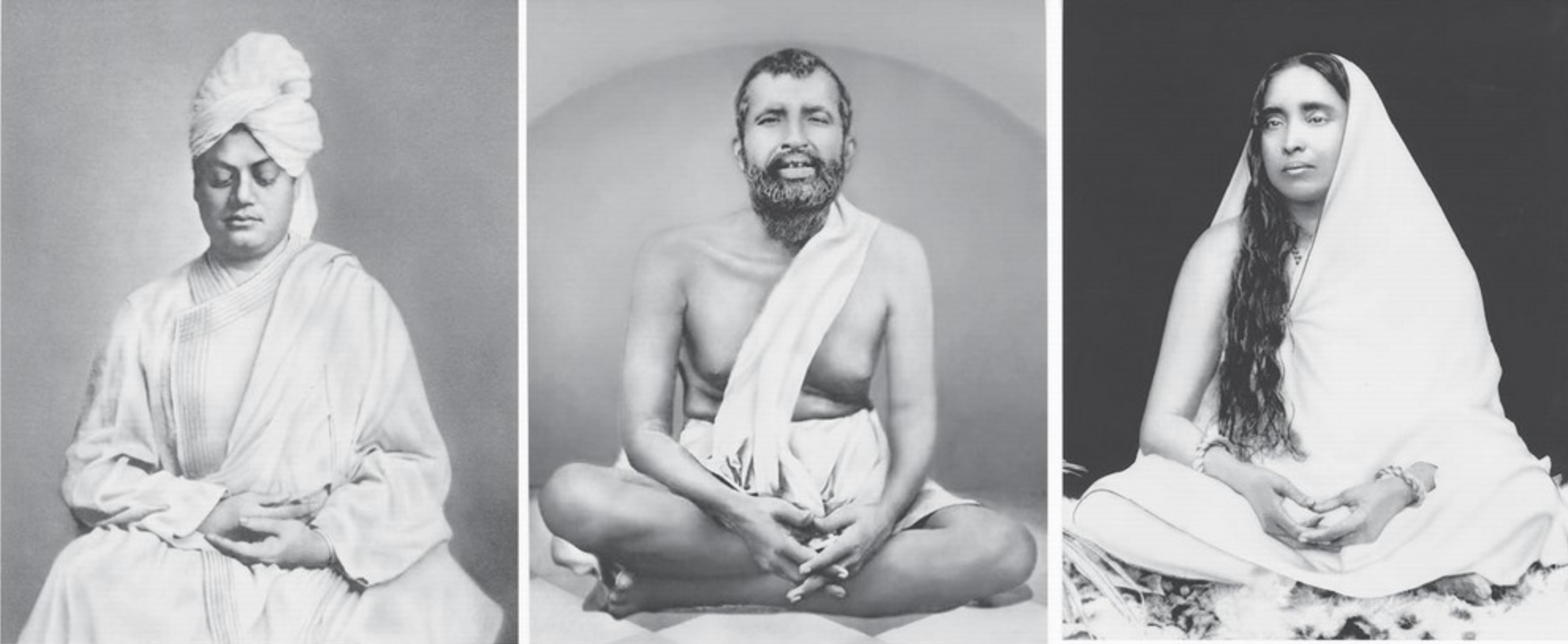
The Mission's work is rooted in what these three lives taught: that service to another being is itself spiritual practice.
"Ātmano Mokṣārtham Jagad-hitāya Cha"
For one's own liberation, and for the welfare of the world— the founding motto of the Ramakrishna MissionSri Ramakrishna lived and taught at Dakshineswar, on the bank of the Ganges north of Kolkata. Householders, monks, and seekers came to his small room from across India. He spoke in parables, in songs, in moments of direct experience that he then patiently explained to those who sat with him.
His central teaching was simple, and radical for his time: that all genuine religions lead to the same truth. He practised, through extended periods of immersion, the disciplines of multiple traditions — devotional Hinduism, Tantra, Vedanta, and, in due course, Islam and Christianity — and reported that each had led him to the same realisation. From this came the foundational Ramakrishna teaching of religious harmony: yato mat tato path, "as many faiths, so many paths."
He also held that the divine resides in every living being. To serve another, particularly one in need, was therefore not charity but worship — shiva jnane jiva seva, "serving the living being as a manifestation of the divine." This single conviction would later become the foundation on which the Mission's work was built.
The Holy Mother was Sri Ramakrishna's spiritual companion through his life and, after his passing in 1886, the inner centre of the small community of monks he had left behind. The relationship between them was not that of a conventional household; she was, from early in their life together, what the tradition calls a sahadharmini — a partner in the spiritual work itself.
Her contribution to the tradition is one of quiet, lived authority. Where Ramakrishna spoke in fierce, vivid spiritual experience, and Vivekananda spoke in the language of public conviction, Sarada Devi wrote and spoke very little — yet shaped the inner discipline of the order through her presence, her counsel to monks and householders alike, and an ethic of accessibility. She turned no one away.
Her most-quoted line carries something of what she meant by motherhood: "I am the mother of the wicked, as I am the mother of the virtuous. Never fear. Whenever you are in distress, say to yourself — I have a mother." In the Mission's institutional life, schools, clinics, and residences named for her — including Shivanahalli's own Sri Sarada Devi Vidya Kendra and Sri Sarada Devi Chikitsa Kendra — are a continuation of that ethic.
Born Narendranath Datta in Calcutta, Vivekananda came to Sri Ramakrishna as a sceptical young man trained in Western philosophy. He left, after his teacher's passing, as the principal carrier of the lineage — and went on to give the Master's vision the institutional form that the world has come to know.
In 1893 he addressed the World's Parliament of Religions in Chicago, opening with the words "Sisters and Brothers of America." It was the moment Sri Ramakrishna's vision reached the wider world. The lecture tour that followed, across the United States and Europe, carried Vedanta into conversations where it had not been heard before.
On May 1, 1897, he founded the Ramakrishna Mission at Belur, on the bank of the Ganges. He held — and persuaded his fellow monks — that the work of a monastic order was inseparable from the work of relieving the suffering of the world. Schools, hospitals, and relief operations were not concessions to worldly demands. They were the practice itself.
"Jiva is Shiva," he wrote — every living being is the divine. The motto under which the Mission was founded distilled this into a single line: Ātmano mokṣārtham jagad-hitāya cha. For one's own liberation, and for the welfare of the world. The two halves were not in tension. They were the same practice.
The work, is the practice.
The Mission is a monastic order whose service is its practice, and whose practice is its service. The schools, the clinics, the forest, the women's self-help groups, the watershed work in the hamlets — all of it is, in the lineage's own terms, spiritual practice carried out through the world rather than withdrawn from it.
To serve another, in this view, is to recognise the divine in them. That is what has been held here, without interruption, since 1897. Shiva jnane jiva seva.
This is what the tradition calls Vedantic humanism — and it is the thread that runs through everything the Mission does.
See the work