
Brahmananda Vana, stop by stop.
One hundred and thirty acres of consciously created forest, on the northern edge of Bannerghatta National Park. This is a guided tour through the Vana — the trees, the ponds, the wildlife, the people who have tended it.
Take your time. Most visitors find an hour or so well spent.
The walk in eighteen stops
Looking up, into three layers of green.
The Vana's vegetation is distinctly multi-layered — a mature canopy above, a developed mid-storey, and a regenerating understorey below. This structure took four decades of patient management to build.
Different species flower and fruit at different times of year, which means the forest is in some state of bloom or seed almost continuously. That continuity is what supports so many birds, insects, and mammals here.
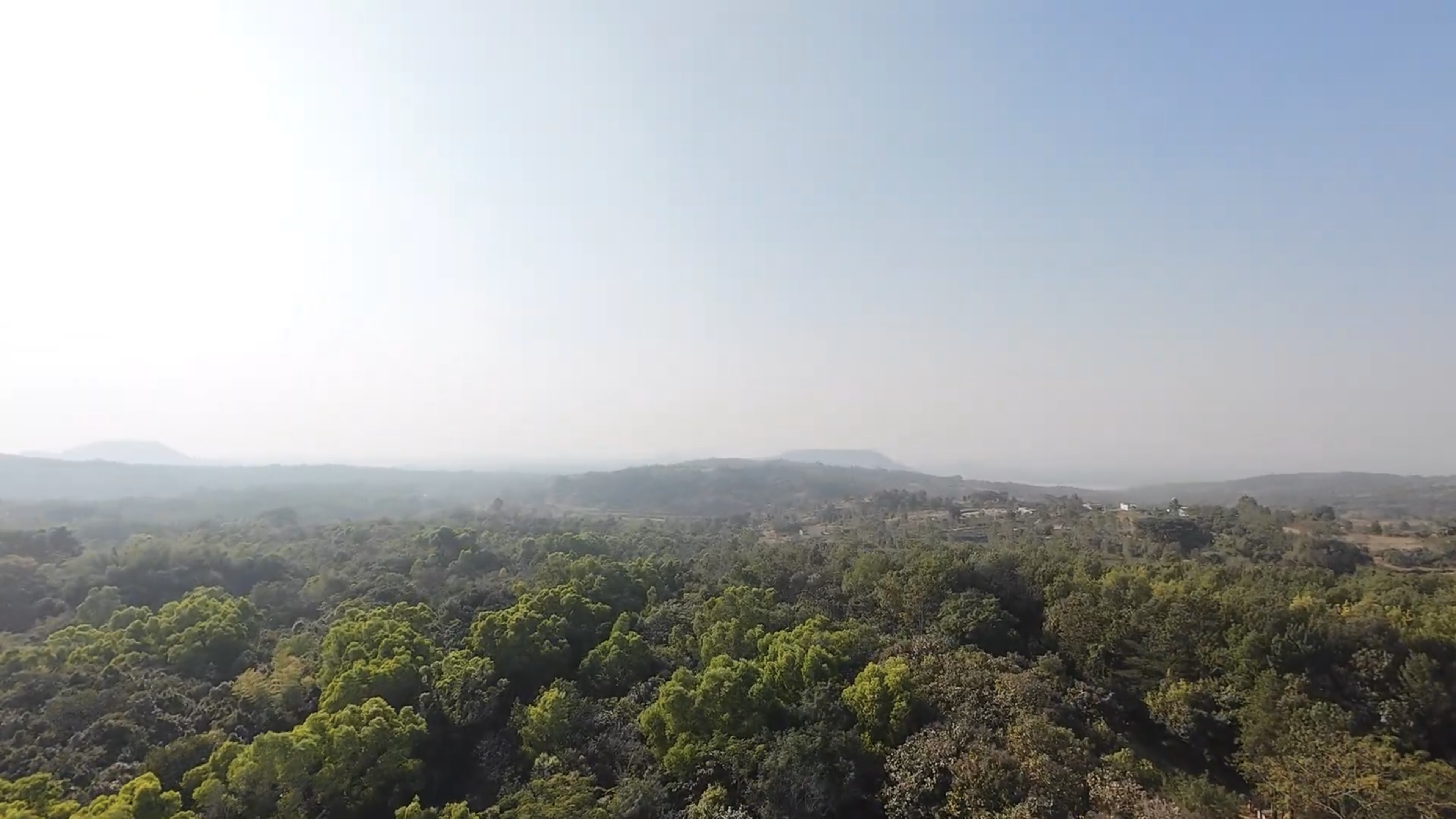
Serpent Eagles View of the Vana
The species were not chosen at random.
The mix was assembled deliberately over decades — Hopea parviflora, Dalbergia latifolia, Spondius Pinnata, Syzygium cumini, and many others, drawn from Western Ghats and tropical assemblages.
There are fodder trees, fruit trees, timber species, shade trees, and plants chosen specifically for their medicinal value. Together they create a canopy that is structurally complex, with layered flowering and fruiting through the year.


The flame of the forest.
Palash, or Butea monosperma — known here as Brahmavriksha and widely called the Flame of the Forest — provides nectar for birds and insects, shade for understory plants, and a strong cultural link to local festivals and medicinal traditions.
Planting Palash in the Vana allows the work of restoration to connect with ideas of health, ritual and story — moving easily between students, elders, monks and visitors.

A photograph of a flowering Palash (Brahmavriksha) on the campus.
A living archive of regional medicine.
The Vana holds more than a hundred and twenty species of medicinal plants — many of which have been lost from the surrounding agricultural and urbanising land.
The presence of these species supports traditional knowledge held by local elders. It is, in a quiet way, cultural infrastructure preserved alongside the ecological one.

Indian snakeroot plant.
The fastest-growing plant on earth.
The bamboo clumps in the Vana include tall, thornless Burmese varieties alongside native species — some reaching twenty metres in height. During the monsoon, culms have been measured growing nearly a metre in a single day.
Beyond their visual presence, the groves stabilise slopes, shade the ponds, and provide nesting and roosting sites for weavers, munias, and parakeets. Students measure the daily growth as a lesson in itself.

Nature Education in the bamboo roots
Four ponds, carefully planned.
The Vana holds four large kalyanis — earthen-walled ponds, planned and built into the landscape, linked to smaller forest pools by channels that carry monsoon runoff. They are not the stepped temple-architecture kalyanis of South Indian tradition. They are ecological infrastructure.
Long-term IISc monitoring between 2013 and 2016 found their water remarkably clean. Total dissolved solids, electrical conductivity, and biochemical oxygen demand all remained low. Plankton sampling recorded at least 41 phytoplankton taxa alongside diverse zooplankton.
On this basis, the principal pond has been classified as oligotrophic — low in nutrients, rich in plankton diversity, far from the nutrient-overloaded urban lakes that surround Bengaluru. IISc described it, simply, as a pristine ecosystem.
A landscape photograph or short video of one of the four kalyanis.
The Indian gaur, at the first pond.
Near the first kalyani, a regular visitor: the Indian gaur, Bos gaurus. Also called the Indian bison, it is the largest living bovine on the planet — bulls can weigh over a tonne, and stand close to two metres at the shoulder.
Gaur are forest animals, dependent on cover and reliable water. That a herd uses the kalyani regularly is, in itself, a measure of what the Vana now is. Forty years ago there was no continuous tree cover here, and no pond for them to drink at.
A photograph of the gaur near the first kalyani — drinking, resting, or moving through.
Two hundred and twenty-two species, and counting.
The Shivanahalli eBird hotspot has accumulated, over many years of patient citizen-science checklists, 222 native and naturalised bird taxa. The list is still growing.
Forest specialists such as Yellow-throated Bulbul share the Vana with raptors like Bonelli's Eagle and Greater Spotted Eagle, alongside a wide spectrum of insect-eating birds, sunbirds, and waterbirds. The continuous canopy and the kalyanis make the Vana an important stopover and resident habitat at the edge of metropolitan Bengaluru.
An audio recording of dawn chorus, or a video of a notable bird species.
Building cavities where the old trees are gone.
Many woodland birds depend on tree cavities to nest or roost — but old, hollow-bearing trees take decades to develop, and remain scarce even in protected forests. To bridge this gap, volunteers and teachers have spent the past year installing wooden nest boxes in selected parts of the Vana.
Local monitoring shows a high occupancy rate — over 31 per cent of boxes used in a given season. Tenants include hornbills, Cinereous Tit, Common Myna, Chestnut-tailed Starling, Oriental Magpie Robin, White-rumped Shama, and Spotted Owlet.
The video on the right shows hornbills tending to chicks inside one such box — a small, intimate window into a process that, in the wild, almost no one ever gets to see.
Hornbills tending chicks in a nest box. Nine minutes — worth the watch.
A nocturnal primate, quietly resident.
The Grey Slender Loris — Loris lydekkerianus — is a small, nocturnal primate with large forward-facing eyes and a slow, deliberate gait. It hunts mainly insects among the branches, moving without descending to the ground.
It is currently listed as Near Threatened, with habitat loss and fragmentation as the main pressures across its range. Regular observations of lorises within the Vana suggest that continuous canopies and quiet nocturnal conditions still exist here, even as the wider landscape urbanises.
A photograph of a Slender Loris from the Vana.
An audio recording of a Slender Loris call. Replace this placeholder with an <audio> tag once the recording is ready.
A leopardess and her cubs, filmed by a camera trap.
Camera traps were installed in the Vana recently, and have already captured large mammals passing through. Among the earliest striking sequences: a leopardess and her two cubs feeding on a deer carcass — a scene that almost no one is ever in a position to witness directly.
The presence of breeding leopards is a reliable indicator that prey populations are stable, that the corridor connecting the Vana to Bannerghatta National Park is functioning, and that the forest is large and quiet enough to support apex predators raising young.
Camera-trap footage of the leopardess and her cubs. Replace this placeholder with the embed once uploaded.
One of the largest moths in the world.
Attacus atlas has a wingspan of over twenty centimetres in females — among the greatest of any insect. The caterpillars feed on the leaves of citrus, cinnamon, guava, and other broad-leaved trees, all of which grow in the Vana.
Adult Atlas moths do not feed at all. They live for only a week or two on fat reserves built up in the larval stage. Their presence here tells us several things: that there are plenty of host plants, that pesticide use is minimal, and that the nights are still dark and quiet enough.
A photograph of an Atlas moth, ideally with something for scale.
The quiet workers that keep the forest alive.
A student-led booklet, Wild Mushrooms of Brahmananda Vana, documents at least ten broad groups of fungi found on the campus — jelly fungi, coral and club fungi, shelf and bracket fungi, stinkhorns, puffballs, cup fungi, bird's-nest fungi, agarics, boletes, and coal fungi.
From an ecological perspective these are the workers that keep the forest floor alive. They are mostly saprotrophs — they feed on dead wood and leaf litter, breaking down complex molecules into forms that plants and microbes can recycle. The diversity of species, on different kinds of substrate, shows that the campus now supports the full cycle of growth, death, and decomposition that characterises a functioning forest.
It is a long way from the bare, sun-baked ground one often sees under young plantations.
A 2×2 gallery from the student mushroom booklet. Translucent jelly fungi, coral fungi, cup fungi, and a bracket species would make a vivid set.
Cooler than the land around it.
The IISc Natural Capital Accounting study used Landsat thermal imagery from 1989 onwards to compare land surface temperatures inside the Vana with the surrounding one-kilometre buffer.
In 1989, when much of the campus was still shrubland, there was little difference. As the forest grew, the pattern shifted. By 2010 the campus was consistently cooler than the buffer in nearly every direction — by several degrees Celsius along the most forested transects.
By 2025 the whole region runs hot in summer, but the forested parts of the Vana still show measurably weaker heat intensity than the lands around them. Forty years of native planting has produced a real, measurable heat refuge.
A heat-map diagram showing the temperature difference between campus and buffer.
What the forest is worth.
If the campus is treated as a single ecological asset, the IISc team has used the System of Environmental-Economic Accounting framework to put numbers on what it holds and what it produces.
The Vana stores approximately 11,000 tonnes of carbon across its biomass and soil. It generates about ₹32.1 million per year in ecosystem services — provisioning, climate regulation, water regulation, cultural value. Projected over fifty years and discounted, the net present value of this natural capital comes to roughly ₹826 million, rising to about a billion when the kalyanis are included.
The value, in scale, is comparable to that of major institutional buildings. But here the asset is a forest and water system that also moderates climate, stores carbon, and supports daily biodiversity.
An image of the IISc report cover, or one of its key data figures.
The Vana sits inside an active corridor.
The Vana is contiguous with Bannerghatta National Park and lies within an active elephant movement corridor. Herds pass through periodically, and the Mission coordinates with the Karnataka Forest Department on management.
This connectivity matters. A forest fragment alone is not enough — what makes the Vana work, ecologically, is precisely that it is not isolated.
A photograph or short video of elephants in or near the corridor.
Forty years of patient work.
None of this happened on its own. Saplings were hand-watered for three years apiece. Soil bunds were laid by hand. Channels were dug, ponds cleaned, paths kept clear — not by a one-time project but by continuous effort across decades.
The work has been carried by the resident monks, by lay workers and gardeners, by visiting volunteers, and by the surrounding hamlets whose own children pass through the Mission's schools — and by the corporate partners who have joined hands and supported it over the years.
A portrait or candid working shot of those who tend the forest.
Sit a while.
You can't build a forest by planting trees alone. A forest is a web of relationships — between the canopy and the soil, between the fungi feeding the roots, between the birds that disperse the seeds, between the moths whose caterpillars feed the birds whose droppings fertilise the soil.
What has been built here, over forty years, is precisely that web. The continuous canopy is what allows the loris to move without descending. The dead wood is what allows the mushrooms to thrive. The mushrooms are what break down the leaf litter into soil. The soil is what holds the water. The water is what keeps the gaur coming back.
None of these things works in isolation. They are not eighteen separate stops on a walk. They are one thing.
The Vana is open to visitors who write ahead. Sit for a while at one of the kalyanis. Walk a single path slowly. Listen.
That is, in the end, what the place is for.
A contemplative landscape — somewhere a visitor might pause.
Plan a visit, or support the work.
The Vana is part of a wider forty-year practice — schools, clinics, livelihoods, and the forest itself. If this walk has moved you to learn more, write to us, or support the Mission's continuing work.